An ethical framework based on the lessons of microbiology
<two videos at the bottom of this page>
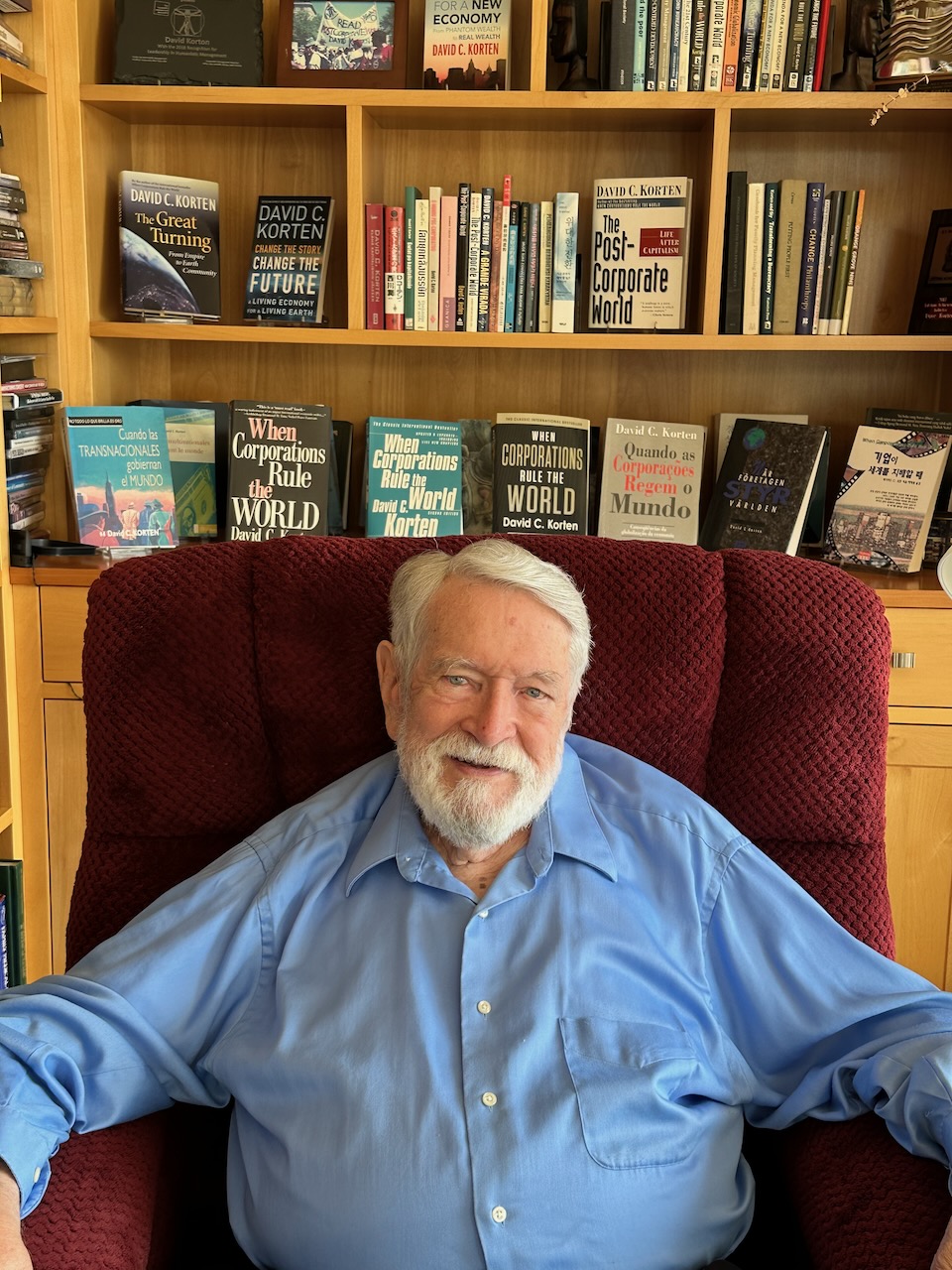
David Korten is an author, lecturer, and former Harvard Business School professor, who is best known for his book When Corporations Rule the World (1995)–the first of his three international best sellers. Initially concerned about the impacts of corporate globalization, he has dedicated the past 30+ years advocating to realign the interests of business with the wellbeing of living people and nature.
Where did this passion come from? I sat down with him in 2025 to dig for answers. I learned that his path to becoming a leading voice for an “ecological civilization” began with lessons learned in his rural Washington upbringing and crystallized through international assignments and some remarkable encounters—all of which reshaped his worldview.
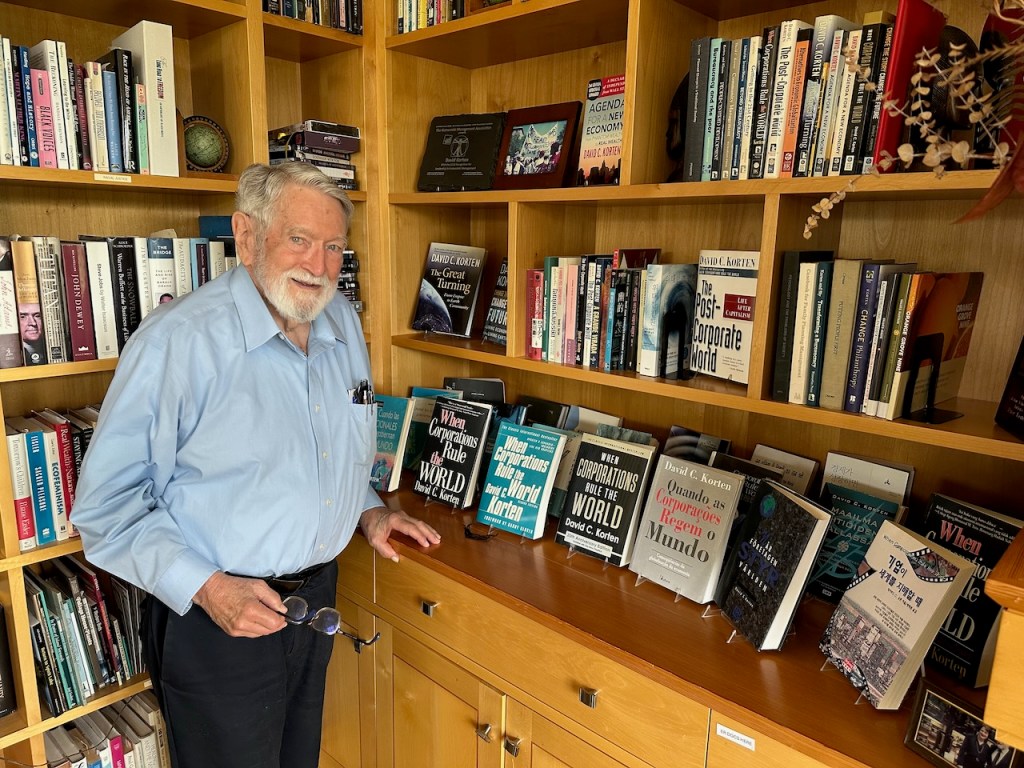
Raised in Longview, Washington, Korten absorbed from his father, a small business owner, the principle that business exists to serve community, not simply to maximize profit. His father’s store sold everything from records and pianos to televisions and appliances, and he offered lessons and repair services so customers could fully utilize and benefit from what they purchased. That ethic of service stood in stark contrast to the shareholder-first ideology that would later dominate American business schools and corporations. It gave Korten an early model of how business could nurture community rather than exploit it.
At Stanford, he studied psychology and later pursued an MBA, convinced that the world could use American business practices to alleviate global poverty. During this time, he met Fran, who would become both his wife and partner in a lifetime of shared work. His plan took them to Africa, Latin America, and Asia, where he combined teaching, research, and advising governments and institutions. In Ethiopia, while conducting his doctoral research, he observed that communities facing nearly identical circumstances could develop very different cultures and social structures. That realization—societies actively choose and shape their futures—became a central theme in his thinking.
Korten later served on the Harvard Business School faculty and with the Harvard Institute for International Development (HIID). During this period, he became increasingly troubled by the transition to a profit-first economic orthodoxy, both in the corporate world and at Harvard. David said a defining moment came when an HIID colleague argued at a faculty seminar that South Korea’s agriculture added nothing to its economy because it “only fed the Korean people.” The absurdity of dismissing farmers who fed their own people as economically irrelevant shocked him into seeing the profound flaws of an economic system that valued profits of transnational corporations over human and ecological wellbeing.
Contributing to his concern, was the release of The Limits to Growth in 1972, a book by a team of MIT scientists based on computer modeling, that has now sold over 30 million copies. It warned that continued “business as usual” trends would lead to environmental and economic collapse within a century. David said “this research laying out the human path to self-extinction was the defining source of my environmental passion. I met and enjoyed deep conversations with the lead author – Donella Meadows – and others that would ultimately help create the environmental movement.”
Following David’s eight years at Harvard, the Ford Foundation hired both Fran and David to serve as staff in its Manila office. They ended up staying in SE Asia (Philippines & Indonesia) for 15 years, serving in a variety of roles. But, they finally faced a turning point. David shared that his close friend and colleague, Indian scholar-activist Smitu Kothari, urged him: “If you and Fran really want to serve the poor of the world, you have to return home and teach your own people what you have learned during your years abroad.”
Taking this advice to heart, the Kortens returned to the United States in the early 1990s. Settling in New York City, David wrote When Corporations Rule the World (1995), the first of three groundbreaking international bestsellers. It warned that global corporations and financial institutions were concentrating economic and political power to create what he called a “suicide economy,” destructive of life and community. The book made him a leading voice in the global debate over corporate globalization. He shared “I even had a vision, at a retreat, of money spreading out across the Asian landscape absorbing life everywhere it touched – like the movie, the Blob.”
Korten experienced a deeper transformation just a few years later. At a 1997 conference in Spain, he met microbiologist Mae-Wan Ho, who introduced him to a radically different way of seeing life. Unlike conventional biology that dissects organisms into parts to study their chemical composition, Ho emphasized life as a constant, dynamic exchange. She noted to David that each human body, for example, is the product of literally tens of trillions of self-organizing living cells that together create and maintain the vessel of our consciousness and the instrument of our agency. To Korten, her vision revealed life itself as a bottom-up, cooperative system rather than a top-down hierarchy. He reflected “What she shared was so extraordinary, and so obvious, but I’d never heard it before. I felt like I learned more about life in 60 seconds with Ho than in my entire formal education!”
<see video of David talking about meeting Mae-Wan Ho below..>
Soon after, David met theologian Marcus Borg who added another dimension to his journey. Borg told David: “Tell me your image of God, and I’ll tell you your politics.” He elaborated. If you view God as an all-powerful ruler, then you likely lean toward an authoritarian top-down approach. If you view the divine as a universal spirit from which Creation emerges, then you likely favor a democratic, bottom-up model.
Together, such insights from Ho, Borg, and other great thinkers deepened Korten’s conviction that humanity must embrace a new cultural and spiritual story—one that affirms our interdependence with and responsibility to nurture life.
I jokingly asked David, what has all of this led to as far as your deepest beliefs? He said it aligns with the principles of the Earth Charter, a global declaration of values and principles for building a just, sustainable, and peaceful society. “It is probably the most inclusive consensus statement ever developed by human beings.” He emphasized three of its core commitments: caring for Earth and one another, advancing equality, and practicing inclusive, democratic decision-making. It reflects no single ideology or creed but instead draws from the wisdom of diverse cultures and traditions.
Spiritually, Korten explained his belief that we best understand creation not through ancient texts alone but by observing how creation unfolds toward ever greater complexity, beauty, awareness, and possibility. Humanity, as Earth’s defining choice-making species, has a profound responsibility to guide this unfolding in ways that sustain life rather than undermine it.
Now living on Bainbridge Island, Washington, he participates in interfaith climate circles and believes in the positive potential of digital communication to connect people across the globe. For Korten, these technologies, often criticized for their downsides, also represent a powerful tool for advancing the sense of interconnectedness essential to building an ecological civilization.
From small-town lessons in service to global critiques of capitalism to transformative encounters with biology and theology, David Korten’s journey has converged on a single, urgent truth: humanity’s future depends on aligning with life’s interdependent, bottom-up design. If we fail to protect Earth, he reminds us, there is no other home to turn to.
Resources & Links
Link to David Korten’s web site: davidkorten.org
Article by David titled: “The Earth Charter: A Progressive Vision Grounded in Conservative Principals”
Link to Earth Charter web site: earthcharter.org/about-the-earth-charter/
David Korten – An Island Treasure: (https://islandtreasureawards.org/awards/korten-david/)
 The Ethos Project
Leave a comment